Airlocks, Bungs, and Stoppers: Getting the Fermentation Seal Right So Oxidation Doesn’t Ruin Your Batch
Fermentation is alive — literally. Your wine is producing carbon dioxide (CO₂) as yeast converts sugar to alcohol, and that gas needs somewhere to go. But here’s the catch: while CO₂ needs to escape, oxygen (O₂) absolutely cannot be allowed back in. Oxygen at the wrong stage turns your wine brown, flattens fruit aromatics, and — in a worst-case scenario involving the wrong bacteria — starts the process toward vinegar. The equipment that solves this problem is deceptively simple: an airlock (a one-way valve that lets gas out but blocks air from getting in), a bung (the rubber or silicone plug that seals the vessel opening and holds the airlock), and a stopper (a solid plug used when you want a completely closed seal, no gas exchange at all). Getting the right combination for the right vessel at the right fermentation stage is one of those details that separates a clean, bright wine from one that tastes “off” in ways that are genuinely hard to diagnose later.
This guide covers every major style of airlock and closure, explains where each one belongs in your workflow, flags the failure modes that forum posts and aggregated reviews keep surfacing, and gives you a clear decision framework based on your vessel type and batch stage. If you already know what an airlock is but have wondered why your three-piece keeps siphoning back into your carboy — or why your S-lock barely bubbles but your wine still tastes oxidized — this is the piece for you.
The Two Airlock Designs: S-Lock vs. Three-Piece
Every airlock operates on the same principle — a water barrier that CO₂ pushes through on its way out but that atmospheric pressure cannot reverse easily. The design differences matter more than they appear on the shelf.
S-Curve (Two-Bubble) Airlock
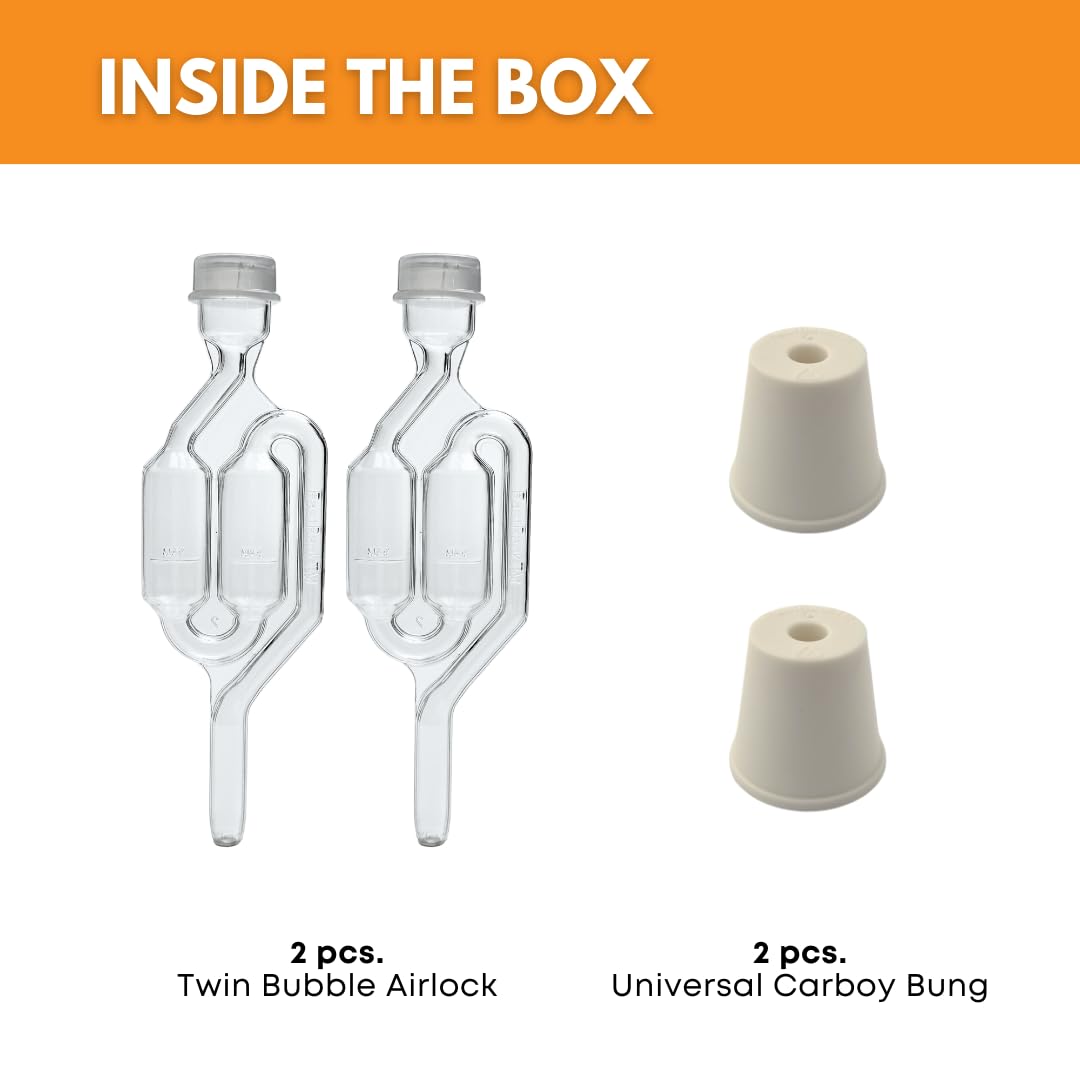
The S-shaped airlock — often called an S-lock — has two liquid chambers in a serpentine curve. CO₂ bubbles up through one chamber and exits through the other. The key practical characteristic: it holds more water (about 1–1.5 mL per chamber) before the seal fails under suck-back.
Where it wins: Carboys during active primary-to-secondary transition, and any vessel that experiences temperature swings. When a carboy cools overnight, the contracting headspace creates slight negative pressure. If that pressure overcomes a shallow water seal, it draws airlock liquid — and potentially ambient microbes — back into your wine. The deeper reservoir of the S-lock gives you more buffer. WineMaker Magazine’s technical Q&A repeatedly flags suck-back as one of the most common undiagnosed contamination sources in home winemaking.
The tradeoff: S-locks are harder to clean. The curved geometry traps sulfite solution and debris, and a bottle brush rarely fits the bends cleanly. Owners in long-run forum compilations (aggregated across winemaking community discussions on BSG Handcraft’s educational resources and MoreWine’s reference manual) consistently note that degraded or discolored S-locks should just be replaced — they’re inexpensive enough that cleaning heroics aren’t worth it.
Three-Piece Airlock
The three-piece (also called a drilled-cap or cylinder airlock) is a straight-sided cylinder with a cap that sits in a shallow moat of water. CO₂ lifts the cap, vents, and the cap drops back. Simpler, highly visible bubble activity, and trivially easy to disassemble and sanitize.
Where it wins: High-activity primary fermentation in buckets or wide-mouth fermenters, and any situation where you want easy visual monitoring. The cap’s visible movement gives you a clear read on fermentation pace that’s less ambiguous than watching a liquid level shift in an S-lock.
The tradeoff: The shallow water moat — typically only about 0.5 mL of fluid — offers minimal suck-back protection. Penn State Extension’s home winemaking guidance on fermentation equipment notes that sealed vessels undergoing temperature cycling are particularly vulnerable to this failure mode with shallow-reservoir locks. For secondary fermentation and bulk aging in glass or stainless, most experienced winemakers default to S-locks precisely for this reason.
Bungs and Stoppers: Fit Is Everything
An airlock is only as effective as the bung sealing it to your vessel. A loose bung — one that allows even a 1 mm gap around the airlock stem — is aerating your wine constantly, regardless of how much sulfite solution is sitting in the lock.
Drilled vs. Solid Bungs
A drilled bung has a center hole sized to accept an airlock stem (standard is 9 mm for most airlocks). A solid bung seals completely with no opening — used during transport, when the vessel is overfull, or during extended bulk aging where you’re relying on SO₂ management rather than active gas venting.
The critical spec is outer diameter. The most common sizing confusion in home winemaking involves carboys. A standard 5- or 6-gallon glass carboy uses a #6.5 bung; a 6-gallon Better Bottle (PET plastic) uses a #7; Italian-style 54-liter glass demijohns typically use a #10 or #11. Getting one size wrong means the bung either falls into the vessel or sits proud and leaks at the rim. Per the MoreWine! Winemaking Reference Manual, this mismatch is the single most common source of airlock-related oxidation complaints from intermediate winemakers — the lock is functioning perfectly but the seal between bung and vessel neck is compromised.
Rubber vs. silicone: Standard stoppers are natural or synthetic rubber, which works fine for typical fermentation timelines. For extended bulk aging (6+ months), silicone bungs are worth the slight price premium. Silicone resists compression set (the tendency for rubber to lose its grip over time and become slightly undersized), and it tolerates SO₂-rich environments without degrading. Operators working with stainless steel tanks and glass demijohns for longer aging cycles consistently report that silicone outperforms rubber for anything beyond a single season.
Sizing Quick Reference
| Vessel | Typical Bung Size |
|---|---|
| 1-gallon glass jug | #5.5 |
| 3-gallon glass carboy | #6 |
| 5–6 gallon glass carboy | #6.5 |
| 6-gallon Better Bottle (PET) | #7 |
| 23-liter demijohn | #9–#10 |
| 54-liter demijohn / carboy | #10–#11 |
Always confirm with your specific vessel — glass tolerances vary by manufacturer.
Fermentation Stage Matters: What to Use and When
The right closure changes depending on where you are in the winemaking process. This is where a lot of otherwise careful winemakers make the same repeatable mistake: using a solid stopper too early, or forgetting to switch from drilled to solid at the right transition point.
Active Primary Fermentation
During peak fermentation — roughly days 1 through 7 depending on your yeast strain and must temperature — CO₂ production is high enough that headspace management is almost automatic. The gas itself is protecting your wine by displacing oxygen. Here the three-piece airlock in a drilled bung is completely appropriate. You want easy visual confirmation that fermentation is progressing, and the high gas outgassing rate means suck-back risk is low.
The Waterhouse Lab at UC Davis, in their published materials on wine chemistry fundamentals, notes that dissolved CO₂ saturation in fermenting must provides meaningful short-term protection against oxidation — which is exactly why many winemakers relax their oxygen vigilance during primary and then get caught off-guard when secondary begins and that CO₂ blanket thins out.
Secondary Fermentation and MLF
Once primary fermentation winds down (below 1.010 on your hydrometer, roughly) and especially once you’ve racked into a clean secondary vessel, the calculus changes. CO₂ production is slow and intermittent. Temperature fluctuations — overnight drops in a basement, seasonal changes in your cellar — now create real suck-back risk. Switch to an S-lock here, and use a potassium metabisulfite (K-meta) solution rather than plain water in the lock. A 1% K-meta solution in the airlock means that even if suck-back occurs, you’re drawing sanitizing solution rather than open air into your wine. WineMaker Magazine’s technical coverage has consistently recommended this practice for secondary and beyond.
If you’re running malolactic fermentation (MLF) — a secondary bacterial process that converts sharp malic acid to softer lactic acid — maintain active venting through the airlock. MLF still produces CO₂, though slowly and often imperceptibly. Do not use a solid stopper during active MLF.
Bulk Aging and Long-Term Storage
Once fermentation is fully complete, SO₂ management becomes your primary oxygen defense. The Practical Winery & Vineyard Journal’s coverage of oxygen management in small-lot production emphasizes that at this stage, the seal between the solid bung and vessel neck is a more significant oxidation pathway than any airlock design consideration. Inspect your solid bungs every 60–90 days during bulk aging. A bung that was snug in October may have lost compression by January if you’re in a climate with significant temperature variation.
For variable-capacity stainless tanks (Speidel, Marchisio, and similar), the floating lid and silicone gasket system largely replaces this concern — but the tank’s pressure relief valve still requires the same routine inspection. Per aggregated operator feedback on professional-grade equipment, the pressure relief valve seal is the most commonly overlooked maintenance point in tanks used for the first time by winemakers transitioning from glass carboys.
The Math That Makes It Concrete
By the numbers — headspace and suck-back risk:
- A 6-gallon carboy cooling from 68°F to 58°F overnight contracts by roughly 0.04 gallons of internal gas volume (~150 mL).
- A three-piece airlock holds approximately 0.5 mL of water in its moat. Full suck-back under normal overnight temperature cycling is possible.
- An S-lock holds 2–3 mL total. The same temperature drop draws down the reservoir but rarely empties it completely.
- Conclusion: for secondary and aging, the S-lock’s extra 1.5–2.5 mL of buffer is not a luxury — it’s the margin between a clean batch and a contaminated one.
Decision Framework: If X, Then Y
If you’re in active primary fermentation in a bucket or wide-mouth vessel → three-piece airlock, drilled bung, plain water or K-meta solution in the lock.
If you’re transitioning to secondary in a carboy or narrow-neck vessel, or your cellar fluctuates more than 10°F overnight → S-lock, correctly sized drilled bung (confirm fit before relying on it), 1% K-meta solution in the lock.
If fermentation is complete and you’re bulk aging for more than 60 days → solid silicone bung, no airlock, regular inspection schedule every 6–8 weeks for compression loss.
If you’re using a variable-capacity stainless tank → follow the manufacturer gasket and valve maintenance schedule; treat the pressure relief valve with the same attention you’d give a carboy bung.
If your S-lock or three-piece is discolored, cracked, or more than one season old → replace it. At $1–$3 per unit, airlocks are the cheapest insurance in your cellar. The MoreWine! Winemaking Reference Manual is direct on this point: consumable fermentation hardware should be treated as a seasonal supply item, not a multi-year investment.
Getting the seal right doesn’t require expensive equipment — it requires matching the right closure to the right stage and actually checking the fit before you walk away from a freshly racked carboy. The variables are small, the consequences of getting them wrong are large, and the corrections are almost entirely within your control.